

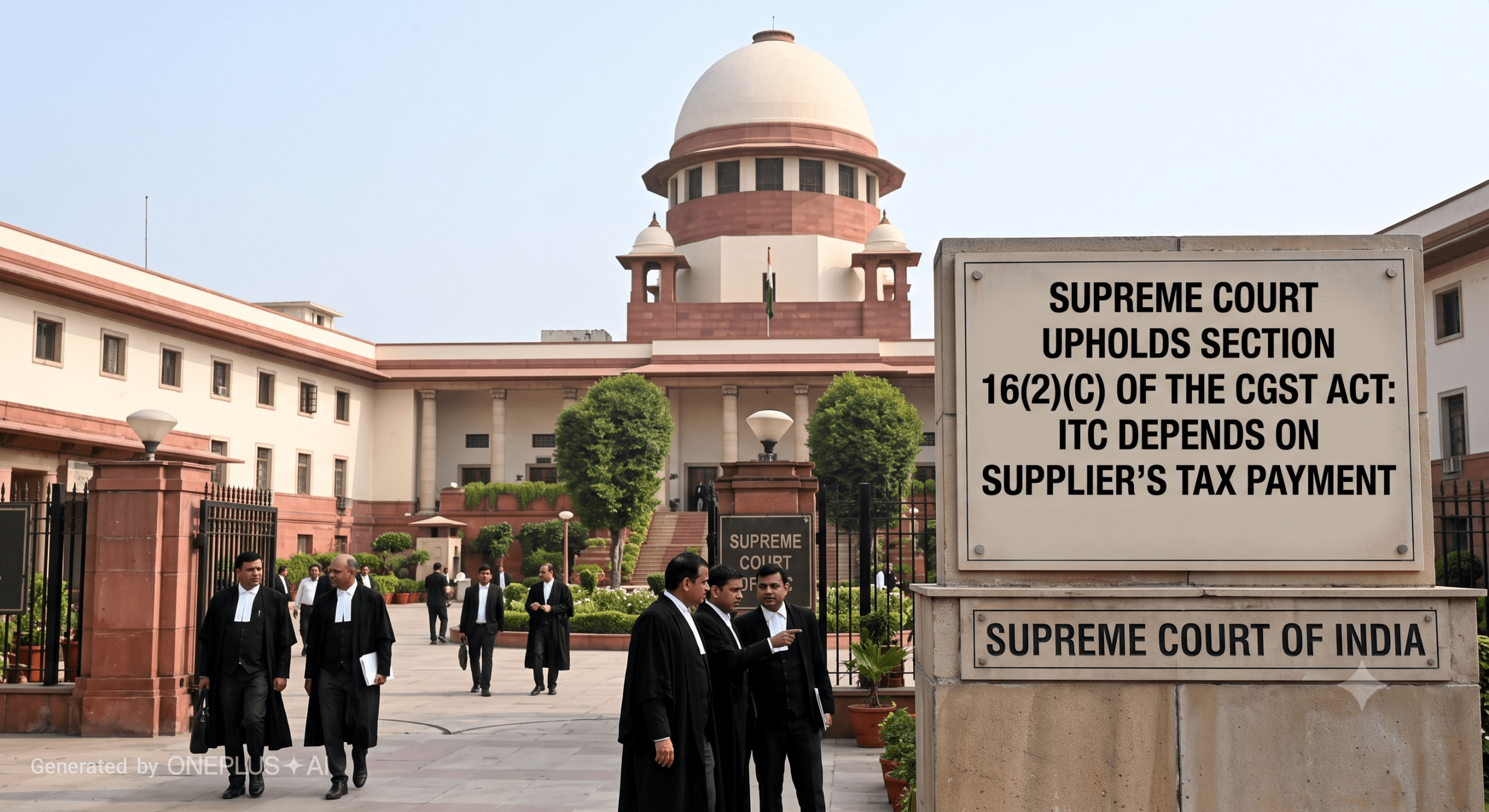
Case Details
| Particulars | Details |
|---|---|
| Case Name | Bhandari Scrap Traders v. Union of India & Ors. |
| Court | Supreme Court of India |
| Issue | Whether Input Tax Credit (ITC) can be denied to the purchaser if the supplier fails to deposit GST with the Government. |
Background
The petitioner argued that a genuine purchaser who had fulfilled the following conditions should not be denied ITC merely because the supplier failed to pay GST to the Government:
- Paid the invoice value including GST.
- Possessed a valid tax invoice.
- Received the goods or services.
The constitutional validity of Section 16(2)(c) of the CGST Act was challenged before the Supreme Court.
Supreme Court’s Decision
The Supreme Court upheld the constitutional validity of Section 16(2)(c) and held that:
- ITC is available only when the supplier has actually paid GST to the Government.
- Mere possession of a valid tax invoice and payment to the supplier do not automatically entitle the recipient to claim ITC.
- If the supplier fails to deposit GST, the recipient’s ITC may be denied.
- Once the supplier subsequently discharges the tax liability, the CGST Act provides a statutory mechanism for restoration of ITC.
Key Findings of the Supreme Court
- Section 16(2)(c) of the CGST Act is constitutionally valid.
- The GST framework is distinct from the erstwhile Delhi VAT regime; therefore, Delhi VAT precedents cannot be applied mechanically to GST.
- Sections 41, 73 and 74 of the CGST Act provide a mechanism for restoration of ITC after the supplier pays the tax liability.
- ITC is a statutory benefit and can be claimed only after fulfilling all conditions prescribed under the CGST Act.
Practical Impact on Businesses
Following this landmark judgment, businesses should adopt stronger GST compliance measures, including:
- Conduct periodic GST compliance checks of vendors.
- Regularly reconcile purchase data with GSTR-2B.
- Monitor suppliers’ GST return filing and tax payment status.
- Include GST compliance and indemnity clauses in purchase agreements.
- Avoid transactions with habitual non-compliant suppliers.
Conclusion
The judgment significantly strengthens the compliance-based framework of the GST law. Businesses can no longer rely solely on possession of a valid tax invoice and payment to the supplier for claiming Input Tax Credit. Continuous vendor due diligence and GST compliance monitoring are now essential to safeguard ITC.
This landmark ruling shifts the focus from document-based ITC to compliance-based ITC, making supplier compliance a crucial factor for protecting Input Tax Credit under the GST law.


(c) of the CGST Act and its impact on GST Input Tax Credit (ITC).)