



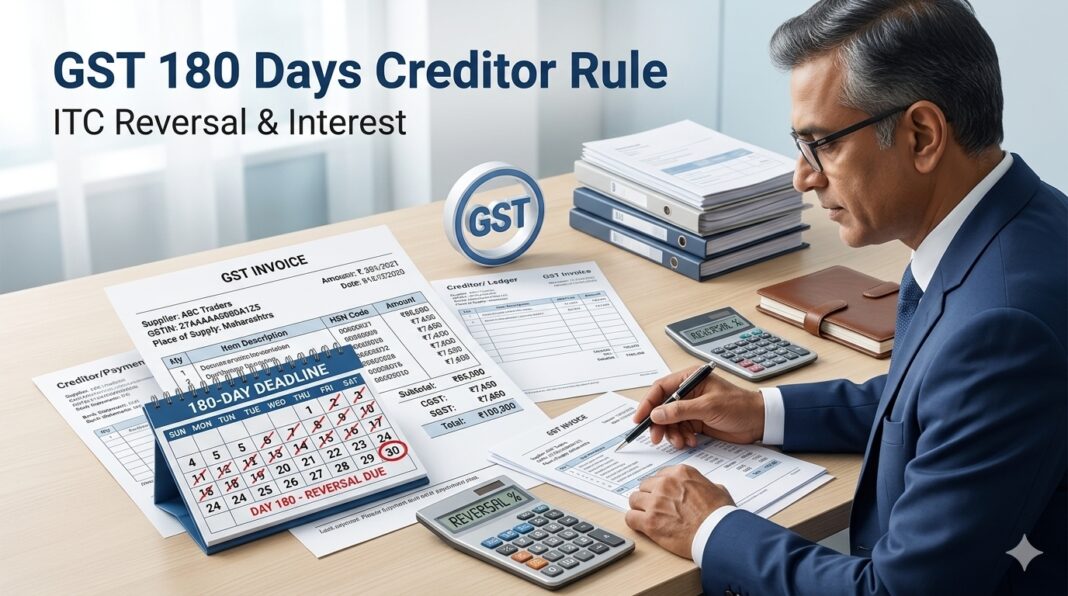

GST 180 Days Creditor Rule: ITC Reversal, Interest & Book Adjustment
Download Auto calculation of 180 days Credit Reversal Excel sheet link is below
Are you carrying old outstanding creditors in your books? If yes, you should check whether any Input Tax Credit (ITC) claimed on those purchases has crossed the 180-day payment period under GST.
The 180 days payment rule under GST is an important ITC compliance requirement. If the recipient does not make the required payment to the supplier within the prescribed period, the ITC relating to the unpaid amount may have to be reversed, along with applicable interest.
For businesses with a large number of vendors, this issue becomes particularly important during GST audits, departmental scrutiny and reconciliation of balance sheet creditors.
In this article, we will understand the GST 180 days rule for creditors, ITC reversal, interest, book adjustment, exceptions and the practical approach to creditor reconciliation.
also readSection 16 of the CGST Act, 2017: Complete Guide to Input Tax Credit Eligibility and Conditions
Table of Contents
- What is the 180 Days Rule under GST?
- Section 16(2) and Rule 37 of CGST Rules
- What Happens When Payment Is Not Made Within 180 Days?
- How Does ITC Reversal Work?
- Does Every Balance Sheet Creditor Require ITC Reversal?
- Is Book Adjustment Considered Payment?
- Paragon Polymer Products Case
- Important Exceptions Under Rule 37
- Does the 180-Day Rule Apply to RCM?
- Interest on ITC Reversal
- GST 180 Days Creditor Example
- Can Reversed ITC Be Re-availed?
- How Should Businesses Reconcile Creditors?
- Free GST 180 Days Creditor Calculator
- Frequently Asked Questions
- Conclusion
Jump To
180 Days Rule |
ITC Reversal |
Book Adjustment |
Interest |
Calculator |
FAQs
1. What is the 180 Days Rule under GST?
The GST law places certain conditions on the availment of Input Tax Credit. One of these conditions is connected with payment to the supplier.
In simple terms, where a recipient has availed ITC on a purchase and does not pay the supplier the required amount within 180 days from the date of issue of the invoice, the ITC related to the unpaid amount becomes subject to the reversal mechanism prescribed under GST.
The provision is particularly relevant for businesses that have old trade payables or outstanding supplier balances.
However, every creditor appearing in the balance sheet does not automatically result in ITC reversal. The nature of the liability and the underlying transaction must be examined.
2. Section 16(2) and Rule 37 of the CGST Rules
The 180-day payment condition is linked to the second proviso to Section 16(2) of the CGST Act, 2017 and the corresponding mechanism under Rule 37 of the CGST Rules, 2017.
Broadly, the provision becomes relevant when:
- The recipient has availed ITC on a supply.
- An amount is payable to the supplier towards the value of the supply and applicable tax.
- The transaction is not covered by the reverse-charge exclusion.
- The required payment remains unpaid beyond 180 days from the invoice date.
Therefore, the invoice date, payment history and ITC claimed should be checked before determining the GST impact.
3. What Happens When Payment Is Not Made Within 180 Days?
If the prescribed payment condition is not satisfied within 180 days, the recipient may be required to reverse the relevant ITC and pay applicable interest in accordance with the GST provisions.
The compliance is not merely an accounting issue. It can directly affect the recipient’s GST liability.
This is why old outstanding creditors should be reviewed periodically rather than only at the time of year-end finalisation.
4. How Does ITC Reversal Work?
The calculation should be connected with the relevant unpaid supply and the ITC attributable to it.
A practical reconciliation should contain at least the following information:
| Particular | Why It Matters |
|---|---|
| Supplier Name | Identifies the vendor |
| Invoice Date | Helps determine the 180-day period |
| Invoice Value | Determines the outstanding consideration |
| GST / ITC | Identifies the credit involved |
| Payment Made | Determines the unpaid portion |
| Outstanding Amount | Helps assess the applicable reversal |
5. Does Every Balance Sheet Creditor Require ITC Reversal?
No. This is one of the most important practical points.
A balance sheet may contain several liabilities that have nothing to do with ITC on taxable inward supplies. Therefore, the total creditor figure should not automatically be considered for ITC reversal.
If a department examines the creditor balance, the taxpayer should ideally be able to produce an invoice-wise reconciliation rather than relying only on the total closing balance.
The following questions should be checked:
- Does the balance relate to a GST supply?
- Was ITC actually availed?
- What is the invoice date?
- How much has already been paid?
- What amount remains outstanding?
- Was the liability settled through any accounting adjustment?
- Is the transaction covered by reverse charge?
- Does any specific exception apply?
6. Is Book Adjustment Considered Payment?
Supplier balances are not always settled through a direct bank transfer. In certain commercial arrangements, parties may settle their respective dues through book adjustment, set-off or another accounting mechanism.
Whether such an adjustment can be treated as payment for GST purposes depends on the facts and nature of the transaction.
The accounting entries should not be viewed in isolation. The underlying transaction, agreement and supporting documents should also be examined.
Businesses relying on book adjustment should maintain adequate documentation showing how the supplier’s liability was settled.
7. Paragon Polymer Products Case
The issue of settlement through book adjustment was considered in Paragon Polymer Products Pvt. Ltd. [2023] 58 TAXLOK.COM 6 (AAR-Kerala).
The Kerala Authority for Advance Ruling considered whether consideration settled through book adjustment could satisfy the relevant payment requirement.
The ruling recognised the possibility of ITC being available where consideration was discharged through book adjustment, subject to the other applicable conditions and restrictions under the GST law.
Practical takeaway: If a taxpayer relies on book adjustment to establish that the supplier liability has been settled, the complete transaction trail and supporting accounting records should be properly maintained.
8. Important Exceptions Under Rule 37
Rule 37 contains specific provisions dealing with certain situations while applying the 180-day payment condition.
Supplies Covered Under Schedule I
Certain supplies covered by Schedule I of the CGST Act are treated as supplies even where they are made without consideration. The rules provide specific treatment for such transactions while applying the payment condition.
Amounts Included Under Section 15(2)(b)
Certain amounts may be required to be included in the value of supply under Section 15(2)(b) of the CGST Act. Such amounts receive specific treatment under the relevant GST rules.
Accordingly, the nature of the outstanding amount should be examined before applying the 180-day rule mechanically.
9. Does the 180-Day Rule Apply to RCM?
The payment condition under the second proviso to Section 16(2) specifically excludes supplies on which tax is payable under the reverse-charge mechanism.
This distinction is important while preparing a creditor reconciliation because an outstanding balance relating to an RCM transaction should not automatically be treated in the same manner as an ordinary supplier invoice for this particular condition.
10. Interest on ITC Reversal
Where ITC becomes liable for reversal because the payment condition has not been satisfied, the applicable interest provisions also need to be considered.
The exact interest liability should be determined after examining the applicable law and the relevant dates involved in the particular case.
For practical working purposes, the reconciliation should separately show:
- ITC potentially requiring reversal
- Applicable interest
11. GST 180 Days Creditor Example
Consider the following example:
| Particular | Amount / Date |
|---|---|
| Taxable Value | ₹1,00,000 |
| GST | ₹18,000 |
| ITC Claimed | ₹18,000 |
| Invoice Date | 1 January 2026 |
| Payment | Not made within applicable period |
Once the applicable 180-day period has expired, the taxpayer should review the invoice and determine the ITC reversal and interest implications as prescribed under GST law.
The calculation should be based on the actual facts rather than simply applying a fixed percentage to the total creditor balance.
12. Can Reversed ITC Be Re-availed After Payment?
Where the required payment is subsequently made, the GST framework provides for re-availment of the relevant ITC subject to the applicable conditions.
Therefore, the reversal mechanism should not necessarily be treated as a permanent loss of ITC. Proper evidence of subsequent payment should be maintained.
13. How Should Businesses Reconcile Creditors?
Businesses should ideally conduct a periodic GST 180 days creditor reconciliation.
A practical Excel working can include:
- Creditor / Supplier Name
- Invoice Number
- Invoice Date
- Taxable Amount
- GST Amount
- ITC Availed
- Payment Made
- Outstanding Amount
- Days Outstanding
- 180 Days Completed – Yes/No
- ITC Reversal
- Applicable Interest
- Remarks / Payment or Adjustment Details
This working can help identify invoices that need attention before a GST audit or departmental verification.
14. Free GST 180 Days Creditor Calculator
15. Frequently Asked Questions
What is the 180 days payment rule in GST?
It is a payment-related condition connected with ITC under Section 16 of the CGST Act. If the prescribed payment to the supplier is not made within the applicable period, the relevant ITC may become subject to reversal along with applicable interest.
From which date are 180 days counted?
The period is considered with reference to the date of issue of the supplier’s invoice.
Does the 180-day rule apply to reverse-charge transactions?
The payment condition under the second proviso to Section 16(2) specifically excludes supplies on which tax is payable under reverse charge.
Can book adjustment be treated as payment?
Depending on the facts, book adjustment may be relevant for satisfying the payment requirement. The nature of the adjustment and supporting documents should be examined carefully.
Is the entire balance sheet creditor amount liable for ITC reversal?
No. The creditor balance should be analysed invoice-wise and transaction-wise. Only the amounts falling within the applicable GST provisions should be considered.
Can ITC be claimed again after payment?
Re-availment may be possible after the required payment is subsequently made, subject to the applicable GST conditions.
Why should businesses maintain an invoice-wise creditor reconciliation?
It helps distinguish GST-related outstanding invoices from other liabilities and provides supporting evidence during audit, scrutiny or departmental verification.
16. Conclusion
The GST 180 days creditor rule is an important compliance area, particularly for businesses having substantial outstanding supplier balances.
At the same time, the rule should not be applied mechanically to the entire creditor balance appearing in the financial statements.
A proper review should consider the invoice date, ITC claimed, amount paid, outstanding amount, nature of the transaction, book adjustments, reverse-charge supplies and applicable exceptions.
Maintaining an invoice-wise reconciliation and reviewing old creditors periodically can help businesses identify potential ITC reversal and interest exposure before a departmental query arises.