



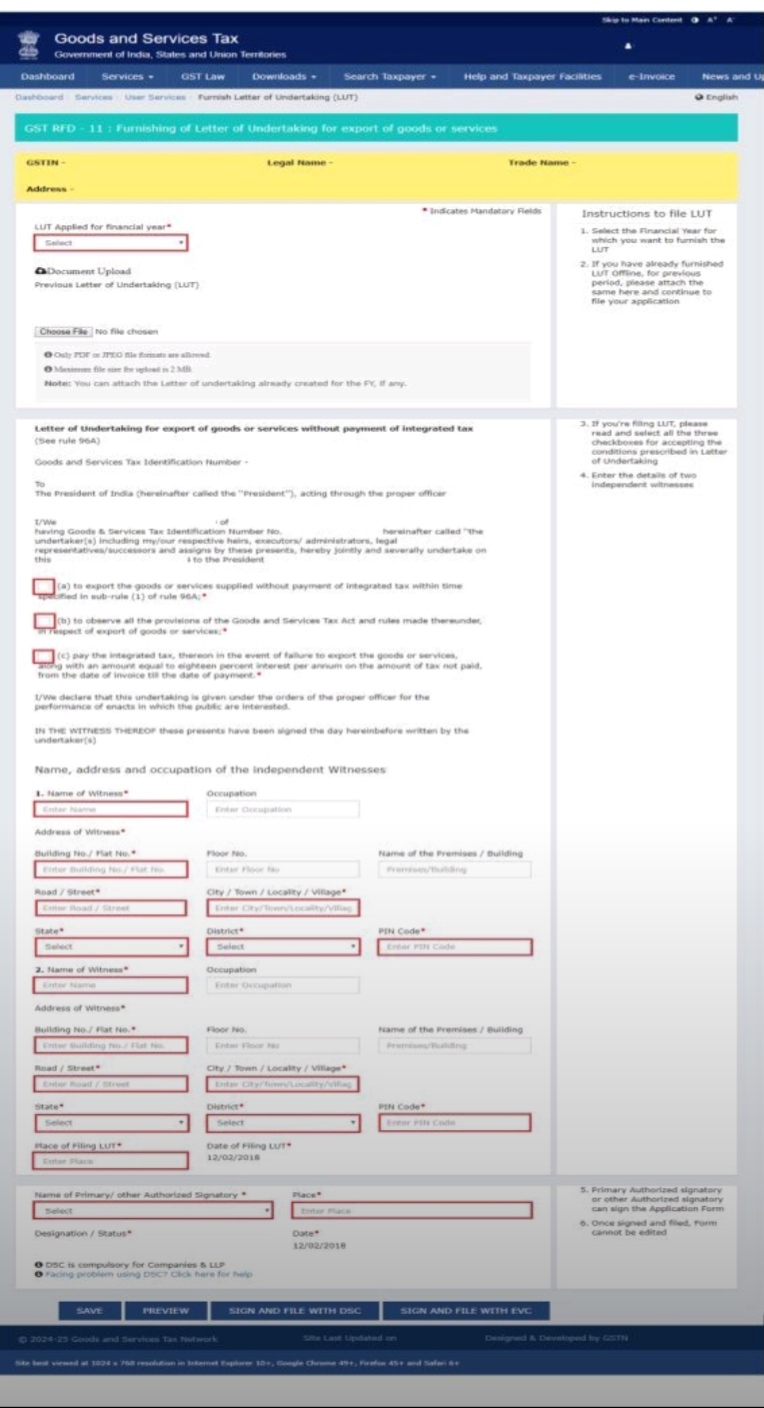

The Goods and Services Tax Network (GSTN) has enabled online filing of Letter of Undertaking (LUT) for Financial Year 2026-27 on the GST portal.
Exporters and suppliers making zero-rated supplies must furnish LUT to export without payment of Integrated GST (IGST).
Legal Basis for LUT Filing
The facility to furnish LUT in place of a bond is backed by:
Section 54 of the Central Goods and Services Tax Act, 2017
Section 20 of the Integrated Goods and Services Tax Act, 2017
Rule 96A of the CGST Rules, 2017
Notification No. 37/2017 – Central Tax dated 04 October 2017
This notification allows eligible registered persons to export goods or services or supply to SEZ without payment of IGST by furnishing LUT instead of a bond.
What is LUT?
A Letter of Undertaking (LUT), furnished in Form GST RFD-11, is a declaration submitted by a registered person undertaking to:
Export goods or services within prescribed time, or
Supply to SEZ units/developers
without payment of IGST, subject to compliance conditions.
Who is Eligible?
All registered taxpayers intending to make zero-rated supplies are eligible to furnish LUT except persons who have been prosecuted for significant tax evasion under GST laws.
Why Filing LUT is Important?
Filing LUT helps exporters:
✅ Avoid blockage of working capital
✅ Export without upfront IGST payment
✅ Maintain smooth compliance
✅ Reduce refund dependency
Validity & Timing
LUT is valid for one financial year only.
A fresh LUT must be filed at the beginning of every financial year.
It should be furnished before making any zero-rated supply in FY 2026-27.
Practically advisable: File on or before 31 March 2026.
Step-by-Step Process to File LUT
Login to GST Portal
Navigate to: Services > User Services > Furnish LUT
Select FY 2026-27
Fill required details
Enter two independent witness details
Accept declarations
Sign using DSC/EVC
Submit and generate ARN
FAQs on LUT for FY 2026-27
1. Is LUT mandatory every year?
Yes, LUT must be filed annually for each financial year.
2. Can LUT be filed after exports begin?
No. It must be filed before making zero-rated supplies.
3. What happens if LUT conditions are not fulfilled?
Tax along with applicable interest may become payable as per Rule 96A.
4. Is LUT filing free?
Yes, there is no government fee for filing LUT.
5. Is LUT applicable to service exporters?
Yes, LUT applies to both goods and service exporters.
6. What if goods are not exported within 90 days under 0.1% concessional rate (Notification 41/2017–IGST)?
If goods are not exported within 90 days, the condition of the notification is violated and the merchant exporter is required to pay GST along with interest. Even if LUT is furnished, liability arises due to non-fulfilment of conditions (ref: Notification 41/2017, Rule 96A, Section 16 of IGST Act).
If export is completed after 90 days, there is no specific relaxation. Issuing a credit note and re-invoicing is not a legally safe option, especially when goods are already supplied. The safer approach is to pay GST with interest and then explore refund, if eligible.
90 Days Rule under 0.1% GST (Notification 41/2017) – Practical Impact
Under Notification 41/2017–IGST, suppliers can supply goods to merchant exporters at a concessional GST rate of 0.1%, subject to the condition that goods must be exported within 90 days from the date of invoice.
What if 90 Days Condition is Not Fulfilled?
If goods are not exported within 90 days, the condition of the notification is violated. In such cases, the merchant exporter is required to pay GST along with applicable interest.
Is LUT Enough to Save Tax?
No, even if LUT is furnished, liability arises due to non-fulfilment of notification conditions. LUT does not override the 90-day requirement.
Export After 90 Days – What to Do?
If export is completed after 90 days, there is no specific relaxation under GST law. The safer approach is to pay GST with interest and then explore refund options, if eligible.
Can Credit Note & Re-Invoicing be Done?
Issuing a credit note and re-invoicing is not a legally safe option, especially when goods have already been supplied. It may be treated as an artificial adjustment by the department.
Conclusion
Taxpayers should strictly comply with the 90-day export condition to avoid interest liability and litigation. Proper tracking of export timelines is essential for smooth GST compliance.
TDS under GST: Meaning, Applicability & Example(Advisory 26 September 2025)
Read more GST Notice Types in India – Complete Guide with Sections (2026)