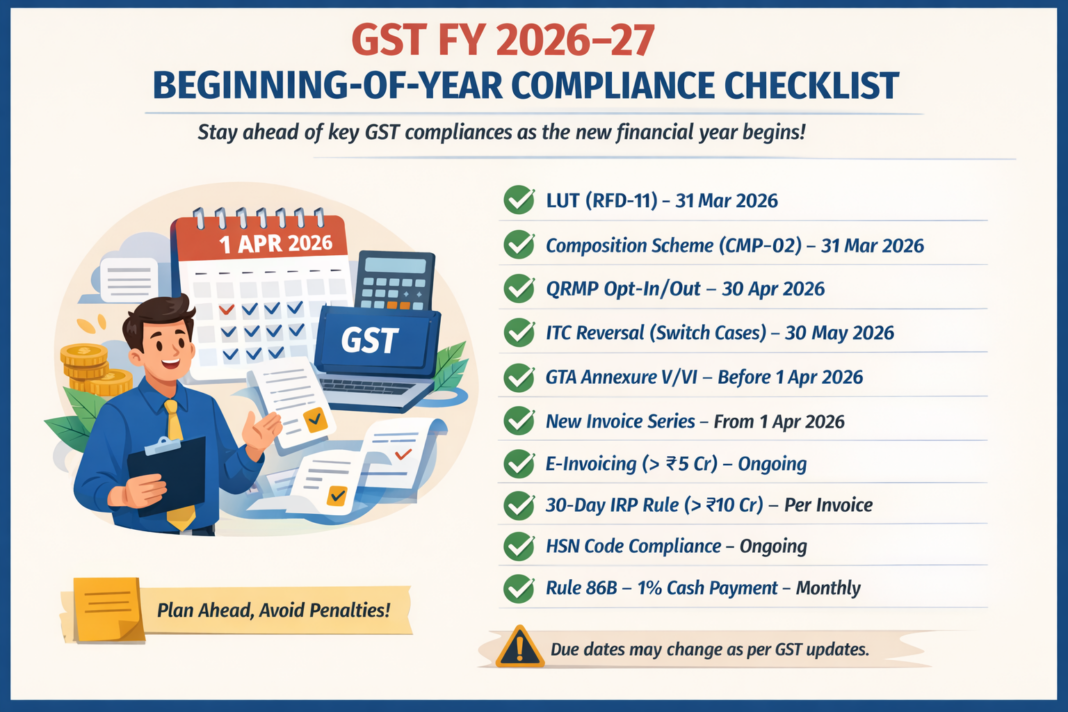



As the new financial year 2026–27 begins from 1st April 2026, taxpayers must ensure timely completion of key GST compliances to avoid penalties, interest, and operational disruptions. A proactive approach at the start of the year helps in smooth tax management and reduces last-minute risks.
✅ Key GST Compliances to Track
1. LUT (Form RFD-11) – Zero-Rated Supplies
Taxpayers engaged in exports or zero-rated supplies without payment of IGST must file LUT before the start of the financial year.
Due Date: 31st March 2026
2. Composition Scheme (Form CMP-02)
Eligible taxpayers opting for the composition scheme must file intimation before the beginning of the financial year.
Due Date: 31st March 2026
3. QRMP Scheme (Opt-in / Opt-out)
Taxpayers can choose or exit the QRMP scheme for quarterly return filing.
Due Date: 30th April 2026
4. ITC Reversal in Case of Scheme Switch
Where a taxpayer switches between regular and composition schemes, Input Tax Credit (ITC) reversal is required on stock and capital goods.
Due Date: 30th May 2026
5. GTA Annexure V / VI Declaration
Goods Transport Agencies must confirm their tax payment option (Forward Charge / Reverse Charge) before the start of the financial year.
Timeline: Before 1st April 2026
6. New Invoice Series Implementation
A fresh invoice numbering series must be adopted from the beginning of the financial year.
Effective From: 1st April 2026
7. E-Invoicing Compliance
Taxpayers with Aggregate Annual Turnover (AATO) exceeding ₹5 Crore must continue complying with e-invoicing provisions.
Status: Ongoing
8. 30-Day IRP Reporting Rule
Taxpayers with AATO above ₹10 Crore must ensure that invoices are reported to IRP within 30 days of issuance.
Applicability: Per Invoice
9. HSN Code Reporting
Ensure correct HSN code reporting (4/6/8 digits) in invoices and returns based on turnover requirements.
Status: Ongoing
10. ISD Registration (if applicable)
Businesses distributing input tax credit through Input Service Distributor (ISD) must ensure proper registration and compliance.
11. Rule 86B Compliance – 1% Cash Payment
Applicable taxpayers must ensure minimum 1% GST liability is discharged in cash, subject to prescribed conditions.
Frequency: Monthly
📌 Practical Tip
Start the financial year with a compliance review checklist, update internal systems (ERP/invoicing), and communicate requirements to your finance and operations teams. Early action reduces the risk of notices and penalties.
⚠️ Disclaimer
This checklist is for general guidance purposes. Exact portal steps and compliance requirements may vary based on updates on the GST portal and notifications issued from time to time.
GST FY 2026–27: Beginning-of-Year Compliance Checklist