




Introduction
Under the GST law, taxpayers are allowed to use Input Tax Credit (ITC) to pay their output tax liability.
However, the government introduced Rule 86B to restrict the complete use of ITC in certain high-value cases.
The main purpose of this rule is to prevent tax evasion and ensure minimum cash payment of GST.
What is Rule 86B?
Rule 86B of the CGST Rules restricts the utilisation of Input Tax Credit for payment of output GST liability.
- Even if a taxpayer has sufficient ITC, a minimum portion of GST must be paid in cash.
- 100% GST payment through ITC is not allowed in specified cases.
- Read moreGST Notice Types in India – Complete Guide with Sections (2026)
When Does Rule 86B Apply?
Rule 86B becomes applicable when all the following conditions are met:
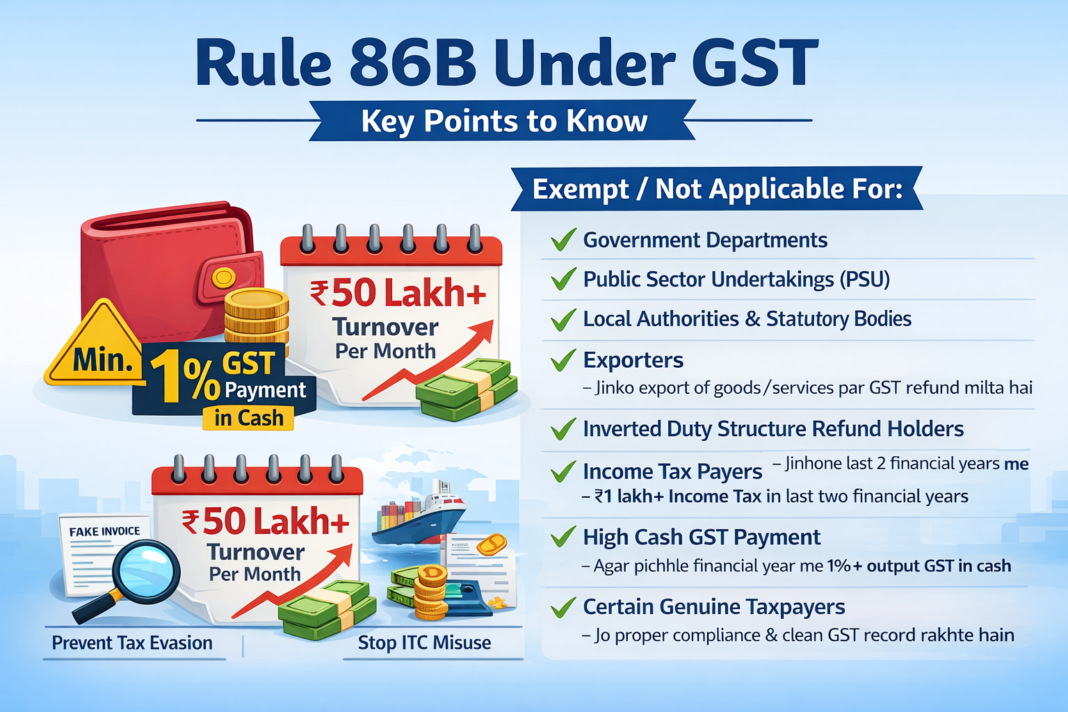
- Taxable outward supplies (excluding exempt and zero-rated supplies) exceed ₹50 lakh in a month
- The taxpayer does not fall under the specified exemption categories
When applicable, at least 1% of the output GST liability must be paid in cash.
Who is Exempt from Rule 86B?
Rule 86B does not apply to the following persons:
- Government departments, PSUs, local authorities, and statutory bodies
- Taxpayers whose income tax paid is more than ₹1 lakh in the last two financial years
- Taxpayers whose GST cash payment exceeds 1% of total output tax liability in the previous financial year
- https://youtube.com/shorts/6dgke1KOam8
Refund-Based Exemptions
- Export of goods or services
- Inverted duty structure
Why Was Rule 86B Introduced?
- To curb fake invoicing and ITC misuse
- To ensure minimum GST payment in cash
- To improve tax compliance
- To increase transparency in GST transactions
Impact of Rule 86B on Businesses
- Businesses with high monthly turnover need better cash flow planning
- Proper GST compliance becomes more important
- Genuine taxpayers remain safe if exemption conditions are met
Key Takeaways
- Rule 86B limits ITC usage in certain cases
- Minimum 1% GST must be paid in cash
- Applicable only when turnover exceeds ₹50 lakh per month
- Several genuine taxpayers are exempt
Conclusion
Rule 86B is an anti-evasion measure aimed at protecting government revenue.
While it increases compliance responsibility, it does not affect honest taxpayers who maintain proper records
and meet exemption conditions. Understanding this rule helps businesses avoid penalties and plan GST payments efficiently.
Read moreKey Changes in GST Return Filing – Effective from October 2025