



. Deductor, GSTR-7, due date aur example.)
By CA Pooja Jain | Last updated: October 2026
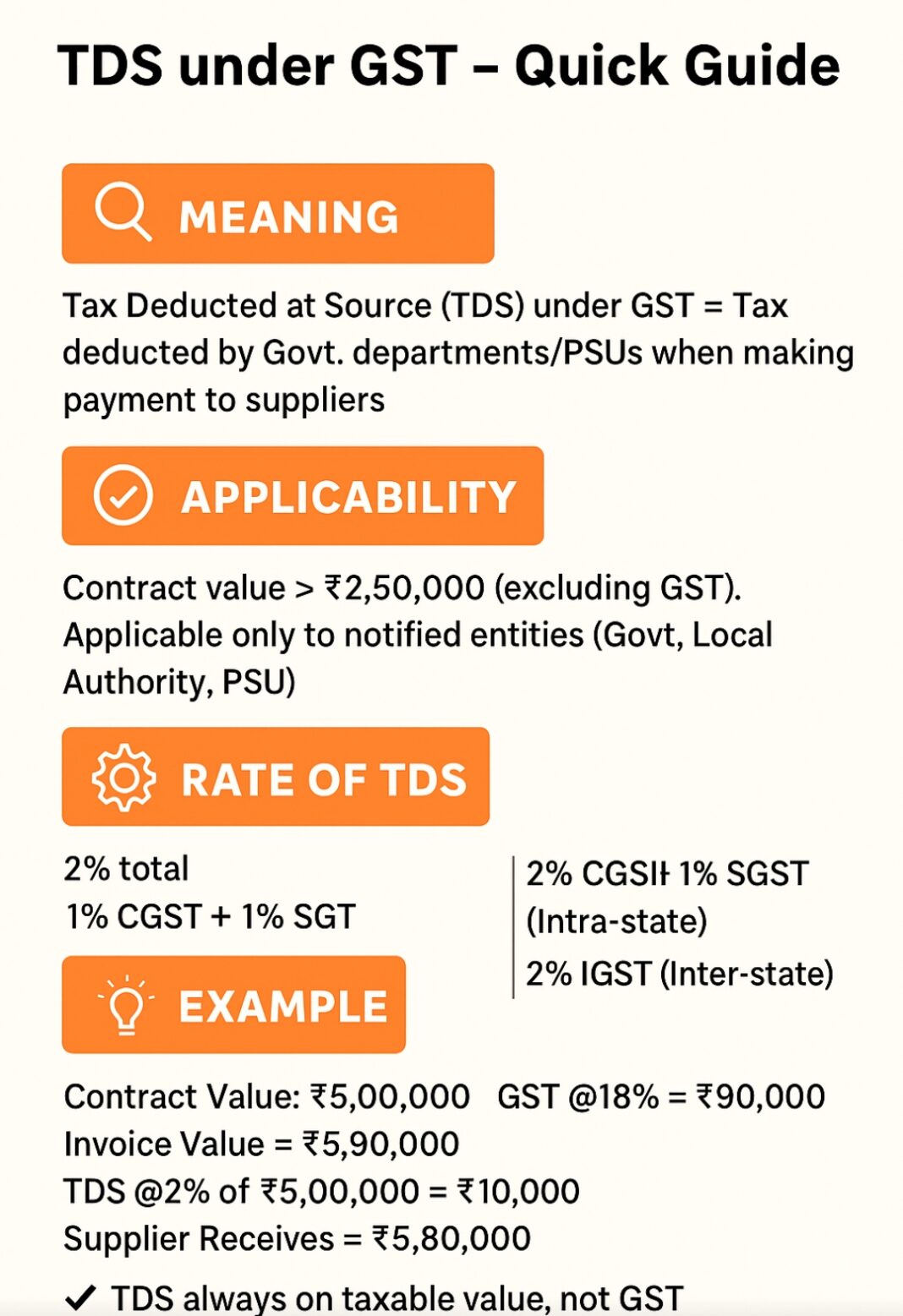
GST TDS applies when a notified deductor, such as a Government department, local authority or PSU, makes payment under a contract worth more than ₹2,50,000 (excluding GST). The rate is 2%: 1% CGST + 1% SGST (intra-State) or 2% IGST (inter-State), as per Section 51 of the CGST Act, 2017.
🔹 What is TDS under GST?
Tax Deducted at Source (TDS) under GST is a mechanism introduced to ensure smooth tax collection and better compliance. When certain notified persons (such as Government departments, local authorities, or public sector undertakings) make payments to suppliers, they deduct a small portion of tax from the payment and deposit it with the Government.
This amount is credited to the supplier’s electronic cash ledger and can be used to pay GST liabilities. These provisions have been effective since 1 October 2018 (Notification No. 50/2018-Central Tax).
🔹 Who Must Deduct TDS under GST?
Under Section 51(1), the following are liable to deduct TDS:
- A department or establishment of the Central or State Government
- A local authority
- Governmental agencies
- Other persons notified by the Government on the GST Council’s recommendation
Through Notification No. 50/2018-Central Tax, these have also been notified:
- Authorities, boards or bodies set up by an Act of Parliament or State Legislature, or established by any Government, with 51% or more equity or control
- Societies established by the Central or State Government or a local authority under the Societies Registration Act, 1860
- Public sector undertakings
Exception: For Section 51(1)(a) persons, authorities under the Ministry of Defence are excluded, except those listed in Annexure-A of the notification and their offices.
🔹 When Does TDS Apply?
TDS applies only when:
- The total value of the taxable supply under the contract exceeds ₹2,50,000 (excluding GST).
- The recipient is a notified deductor listed above.
TDS is not deducted on exempt goods or services (Sec. 51(1)), on contracts of ₹2.5 lakh or less, and in cases covered by Notification No. 73/2018-Central Tax.
🔹 TDS Rate under GST
| Type of supply | Rate |
|---|---|
| Intra-State | 1% CGST + 1% SGST |
| Inter-State | 2% IGST |
🔹 Practical Example
A Public Sector Undertaking awards a contract:
| Item | Amount |
|---|---|
| Contract value (excl. GST) | ₹5,00,000 |
| GST @ 18% | ₹90,000 |
| Total invoice value | ₹5,90,000 |
| TDS @ 2% of ₹5,00,000 | ₹10,000 |
| Amount paid to supplier | ₹5,80,000 |
The ₹10,000 is deposited with the Government and reflects in the supplier’s GST cash ledger.
🔹 Compliance: What Deductors and Suppliers Must Do
Deductor
- Register as a deductor (Rule 12). TAN can be used instead of PAN.
- Deposit the tax within 10 days after the end of the month of deduction (Sec. 51(2)).
- File GSTR-7 (Rule 66).
- Issue the TDS certificate (GSTR-7A) to the supplier (Sec. 51(3)). Late issue attracts a fee of ₹100 per day after 5 days from the date of payment to Government (Sec. 51(4)).
Supplier
- Check that the deducted amount appears in your electronic cash ledger (Sec. 51(6)).
- Match it with GSTR-7A and the payment received.
If tax is collected but not paid to the Government, Section 76 applies. If it is wrongly collected and paid, Section 77 applies.
Latest Update: Invoice-wise Reporting in GSTR-7
GSTN Advisory No. 626 dated 26 September 2025 introduced invoice-wise reporting in GSTR-7, following Notification No. 09/2025-Central Tax dated 11 February 2025. From the September 2025 tax period, deductors must report TDS invoice-wise, so keep invoice-level data ready before filing.
🔹 Important Points to Note
- TDS is calculated on the taxable value, not on GST.
- The deducted amount is available to the supplier as credit in the cash ledger.
- Delay in deposit or non-compliance can attract interest, late fee and other consequences under the Act.
- TDS applies only to notified persons, not to all businesses.
🔹 Why TDS Matters in GST
- Helps the Government track transactions more effectively
- Improves compliance and reduces the chances of tax evasion
- Assures suppliers that deducted tax will be credited to their ledger
Also read:
🔹 FAQs
What is the rate of TDS under GST?
2% in total: 1% CGST + 1% SGST, or 2% IGST.
Is GST TDS applicable below ₹2.5 lakh?
No. It applies only when the contract value exceeds ₹2,50,000, excluding GST.
Who is liable to deduct GST TDS?
Government departments, local authorities, governmental agencies, and notified persons such as government-controlled bodies, societies and PSUs.
Which forms are used?
GSTR-7 for the return and GSTR-7A for the certificate.
How is GST TDS different from Income Tax TDS?
GST TDS is under the CGST Act and is credited to the supplier’s GST cash ledger. Income Tax TDS is under the Income-tax Act and appears in Form 26AS/AIS.
Since when is TDS under GST applicable?
From 1 October 2018.
🔹 Conclusion
TDS under GST is an important compliance requirement for Government bodies and notified entities. Suppliers working with them should understand these provisions to avoid disputes and ensure timely credit. If you deal with Government contracts, keep proper records of every TDS deduction.
📌 Reference: Section 51, CGST Act, 2017; Notification Nos. 50/2018 and 73/2018-Central Tax; Circular No. 65/39/2018
📢 Stay updated with simplified GST guides, rulings and compliance tips on Taxlly.